
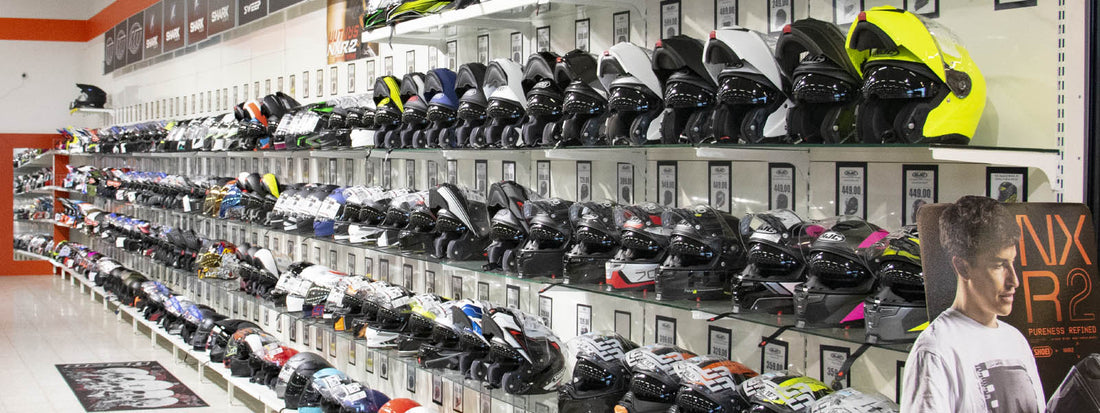
How to fit your new helmet!
Share
The importance of a proper helmet fit is undeniable for the safety of a motorcyclist. A good fit affects many different factors, which together ensure the protection and comfort of the helmet. The importance of a good fit cannot be overstated, as the benefits of even the finest and most expensive helmet in terms of both use and safety are lost if the helmet does not fit correctly and securely. In this guide, we will delve into the different dimensions of helmet fit.
It's not worth skimping on safety.
The primary function of a helmet is to disperse impact forces and thus protect your head. This protective mechanism only works properly if the helmet fits properly and securely.
Safety standards such as the ECE 22.06 mandatory for helmets in Europe are based on laboratory tests in which the helmet is tightly fitted to a "standard" head. In the real world, a poorly fitting helmet significantly reduces the protective effectiveness of the tests, also based on the tests. For this reason, manufacturers constantly emphasize the importance of the correct size because it is not just a matter of comfort, but a real life-saving factor.
A little knowledge of anatomy.
People's heads vary in circumference between approx. 50–65 cm, and the majority are between 54-62 cm, but an extremely large factor is also your head shape in addition to circumference. A round, semi-oval or elongated "skull shape" requires different models from different manufacturers. The majority of current helmet models are manufactured to fit the so-called semi-oval head, as according to research it covers approx. 85-90% of all human head shapes.
Modern helmets often offer interchangeable pads to accommodate different shapes, but the basic size must be correct.
Measuring head circumference:
- Measure the circumference of your head approximately 2.5 cm above your eyebrows.
- Move the measuring tape slightly to find the largest measurement.
- Compare the measurement to the manufacturer's size chart.
- If your measurement is between two sizes, try the smaller helmet size first.
Remember that the numbers in the size charts are just a guideline, not a law. Two helmets with the same size number from different brands may fit completely differently due to, for example, the shape of the interior. Shoei helmets are often semi-oval, Schuberts are round, etc. The only way to determine the correct fit for your head shape is to try on different helmets.
The importance of helmet padding in fit.
In a good helmet, each component works in synergy to keep the protection in place:
The crown pads should press evenly against the top of your head without any pinching. The crown pads are the thinnest pads in the helmet, so they also don't give as much with use as the cheek pads. For this reason, if you experience pressure points on the top of your head when quickly adjusting (forehead, back of the head, sides) it often means that the helmet is too tight or its shape doesn't fit your head.
Cheek pads are a structural part that supports the helmet from the side and seals the neck area, reducing noise from entering. The cheek pads on a new helmet should feel tight – they will adjust to their natural position after 10–15 uses.
Don't forget to tighten the chin strap , as it's the only part that locks the helmet to your head. When tightened properly, it should only allow a few fingers to fit under your neck. A strap that is too loose won't hold the helmet in place in a crash, while a strap that is too tight will cause discomfort when you move your head, for example.
ROTATION TEST STEP 1
1. Fasten the chin strap securely.
2. Place your hands on the back of the helmet.
3. Try to push the helmet off by "rotating" it forward -> try to rotate the visor opening downwards.
ROTATION TEST PHASE 2
1. Place your hands on the front of the helmet.
2. Try to push it away by rotating it backwards -> try to rotate the visor opening upwards.
With the right size helmet, there should be minimal movement and the helmet should stay securely in place.
Special attention needs to be paid to the position of the line of sight . The eyes should be focused quite close to the center of the visor. Also note that often on sporty helmets the line of sight is "optimized" for the riding position of a sports bike where the gaze is slightly upward.
Strictness is not always a bad thing.
A new helmet should feel "tight but not painful." The cheek pads may feel tight at first, but this should ease with use. Persistent pressure on the forehead, headaches, or numbness are signs of the wrong size.
Don't just rely on a quick fit in the store. Although our sales staff is trained to ensure that every customer leaves with a helmet that fits properly, we recommend that everyone try it on at least 45 minutes at home, which can reveal hidden pressure points that may not be immediately apparent.
Maintenance tips for maintaining the fit.
The fit of a helmet changes over time.
Replacing the pads : Replace the cheek pads and head pads every 2-3 years when they have lost their elasticity or if the fit has otherwise become too loose.
Belt adjustment : Remember to check the belt tension and condition from time to time.
Remember: The best helmet is the one you literally forget is on your head. When safety and comfort are in order, your focus shifts to the joy of riding.
Why buy your helmet from Eurobiker?
We promise to give you the best experience when it comes to buying helmets through us, whether you shop online or in-store. We also offer professional service via phone and email.
Here are a few reasons to buy from us instead of European online stores:
- We are a completely Finnish company, and our taxes and salaries are also paid in Finland.
- Competitive prices.
- We offer the easiest and fastest exchange and return policy in the industry, especially for helmet fitting. You can always exchange a helmet for another size or return it if it doesn't fit your head.
- When buying a helmet in the store, it is also possible to take a test ride! It is worth asking the seller about this if you are wondering how one of our helmets will work while riding.